Notes on Genus: Begomovirus
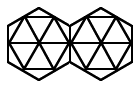 |
twinned icosahedra
Type member: Bean golden yellow mosaic virus
Contents
- Members of this Genus
- General Description
- Morphology
- Electron Micrograph
- Genome
- Genus Genomic Organization
- Genome Map
- Type Member Genomic Organization
- All Known Sequences
- Curated Sequences
General Description
This is one of 7 genera in the family Geminiviridae. It is also known as geminivirus Subgroup III or the bean golden mosaic virus group. It differs from the other geminivirus genera in (usually) having a bipartite genome and because its members are transmitted by whiteflies (Bemisia spp.). Plant hosts are all dicotyledonous.Morphology
Virions are geminate (twinned) icosahedra, not enveloped, 38 nm long and 22 nm in diameter. 22 capsomeres per nucleocapsid.Genome
Usually bipartite, closed circular, single stranded DNA. Both DNAs are required for full systemic infection. The two segments are similar in size (2400-2800 nucleotides). The New World and African members are nearly always bipartite, whereas many members from the Indian subcontinent and from China are monpartite. However, these monopartite members are often (perhaps always) associated with a smaller satellite DNA beta, that is responsible for symptom production. Additional nanovirus-like satellite components, known as alphasatellites may also be present.Genus Genomic Organization
ORFs occur on both genome segments (if present) and in both the virion (+) and complementary (-) senses.Component A (or the complete DNA of single component members) typically has 6 open reading frames, 2 in the virion sense (one of which encodes the coat protein) and 4 in the complementary sense, most of which are involved in virus replication.
Component B (where present) always has two open reading frames, one each in the virion and complementary sense, encoding products involved in virus spread within plants.
A non-coding region of about 200 bases occurs on both DNA segments: this is highly conserved amongst geminiviruses and has regions capable of forming hairpin loops. It may be involved in RNA transcription and DNA replication. These regions are virtually identical on the two DNA segments.
Type Member Genomic Organization
Two segments of 2647 (DNA-A) and 2585 (DNA-B) nucleotides. A total of 8 open reading frames (ORFs) have been identified and they occur on both genome segments and in both senses:
| ORF | Sense | Product |
| DNA-A has 6 ORFs recognised in most viruses in this genus: | ||
| AV1 (AR1) | + | 29.7 kDa, Coat protein |
| AV2 | + | 12.8 kDa, Movement protein ("precoat" ORF) |
| AC1 (AL1) | - | 40.2 kDa, Replication initiation protein (Rep) |
| AC2 (AL2) | - | 19.6 kDa, Transciption activator protein (TrAP) |
| AC3 (AL3) | - | 15.6 kDa, Replication enhancer |
| AC4 | - | 12.0 kDa, possibly determining symptom expression |
| DNA-B has 2 ORFs recognised in all bipartite viruses in this genus: | ||
| BV1 (BR1) | + | 33.1 kDa, Nuclear shuttle protein |
| BC1 (BL1) | - | 29.6 kDa, (cell-to-cell) Movement protein |